Category: Make Most of Small House · #Small-Space
💰 Cost: €500–€8,000 depending on scope · 🔧 Difficulty: Moderate to Complex — layout changes benefit from a professional
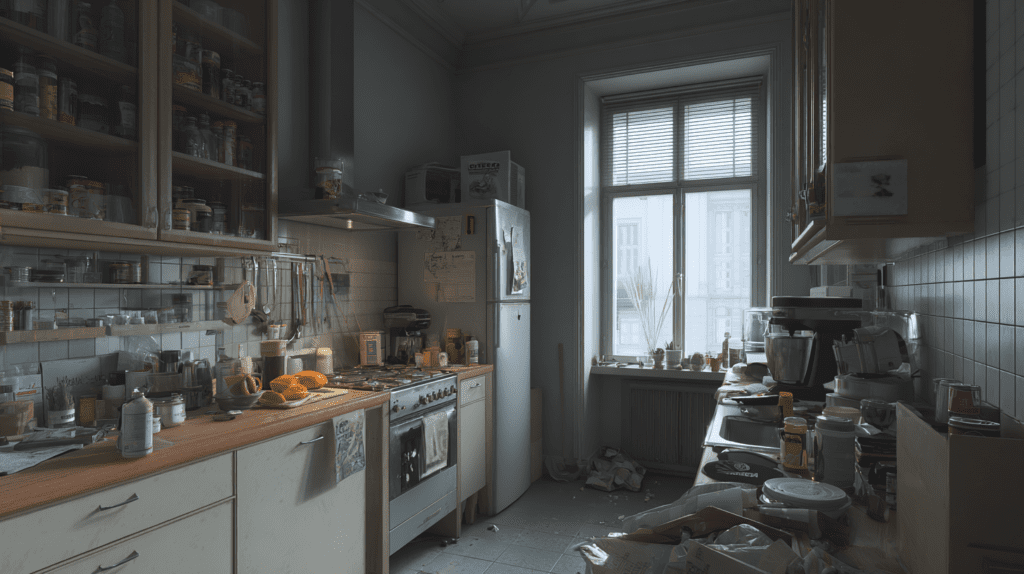
Your small kitchen defeats you before you’ve even started cooking. The chopping board has nowhere to go. The pan you need is behind three others. Someone opens the fridge and you have to step aside. You manage, of course — but every meal carries this low-level friction that turns cooking from something enjoyable into something you just get through. And on the evenings when someone else is also in there trying to help, it becomes genuinely difficult.
The frustrating thing is that most people assume this is simply what small means. That living in a 60 m² Berlin Altbau with a 6 m² kitchen is just a compromise you accept, and the best you can do is buy a few organisers from IKEA and tolerate the rest. But that assumption is wrong. The problem almost never comes down to how many square metres you have. It comes down to what’s happening with those square metres — and in most small kitchens, the answer is that they’re being wasted in ways that are completely fixable.
In this guide you’ll find a practical framework for rethinking your small kitchen from the layout up — covering the three changes that make the biggest difference to how a small kitchen actually feels and functions, what they cost in Germany, and when a carpenter or kitchen fitter makes the difference between a minor refresh and a transformation.
Why your small kitchen feels smaller than it actually is
Most small kitchens don’t fail because of their size. They fail because of three compounding problems that the original design almost never solves: a work triangle that doesn’t work, storage that’s placed at the wrong height, and lighting that flattens every surface into the same grey plane. Any one of these would make a kitchen harder to use. Together they make even a well-equipped kitchen feel impossible.
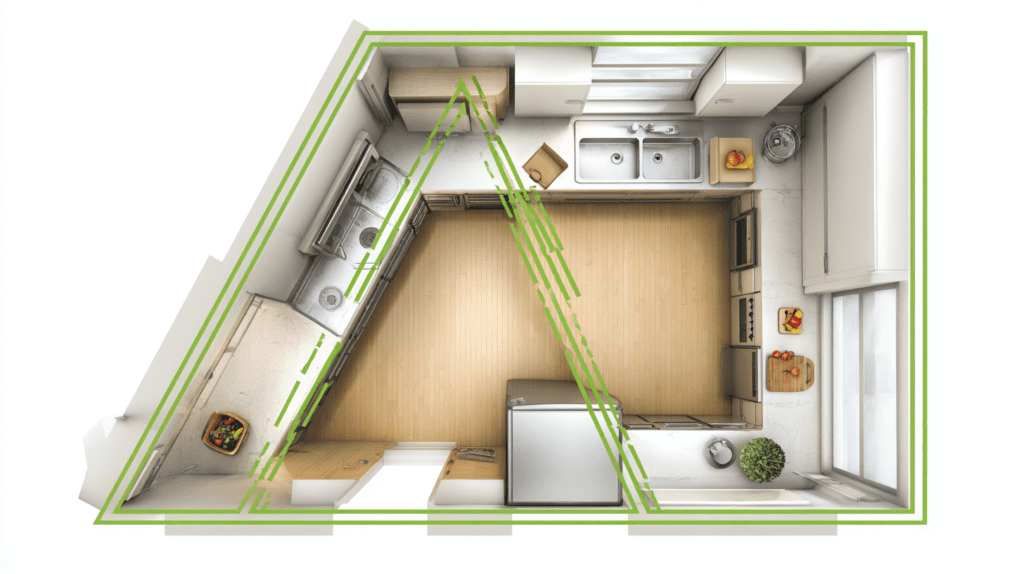
The work triangle is the spatial relationship between your hob, your sink, and your fridge. In an ideal kitchen these three points are close enough to move between efficiently but far enough apart that two people can use different areas simultaneously. In most small German Altbau kitchens — where the original layout was designed for a single occupant using the space for basic cooking — the triangle is either too compressed (everything is on one wall, one step from everything else, with no clear workflow) or completely inverted (fridge on one side, sink on the other, hob in the middle, meaning every meal involves crossing the kitchen four times per dish).
The lighting problem is just as consequential and much cheaper to fix. A small kitchen with a single ceiling light and no under-cabinet task lighting will always feel cramped — because the shadows thrown by your own body while you work make every surface feel darker and smaller than it is. Under-cabinet LED strips cost €40–€80 and transform how a small kitchen feels to work in, instantly. This is consistently one of the highest-return changes in any small kitchen: it costs almost nothing, takes an afternoon to fit, and the difference is immediately visible.
The small kitchen storage mistake almost everyone makes
In a small kitchen, most people’s instinct is to add more storage. A new shelf here, a magnetic knife strip there, a set of hooks on the inside of the cabinet door. Each addition is rational in isolation. The result is a kitchen that feels more cluttered than before the storage was added — because the additions are visible, and visible storage in a small space reads as chaos even when everything has a place.
The actual storage problem in most small kitchens isn’t quantity — it’s placement and concealment. Specifically: items used daily are stored where they’re hardest to reach, items used rarely take up prime counter-height space, and the area between the tops of upper cabinets and the ceiling (typically 40–60 cm in a German Altbau) is completely wasted.
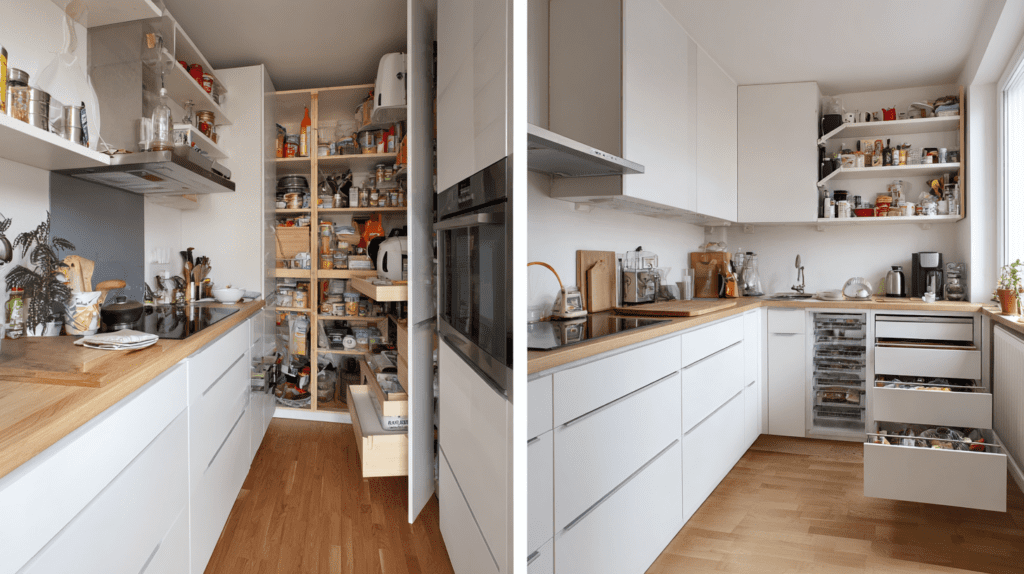
The fix has three parts. First, ceiling-height cabinets. In most German Altbau kitchens, the upper cabinets stop 50–60 cm below the ceiling. That gap is the most wasted storage in the room. Taking the cabinets to ceiling height recovers the equivalent of one full additional cabinet unit — without adding a single centimetre of floor space. However, this is a job for a carpenter, not a flat-pack addition.
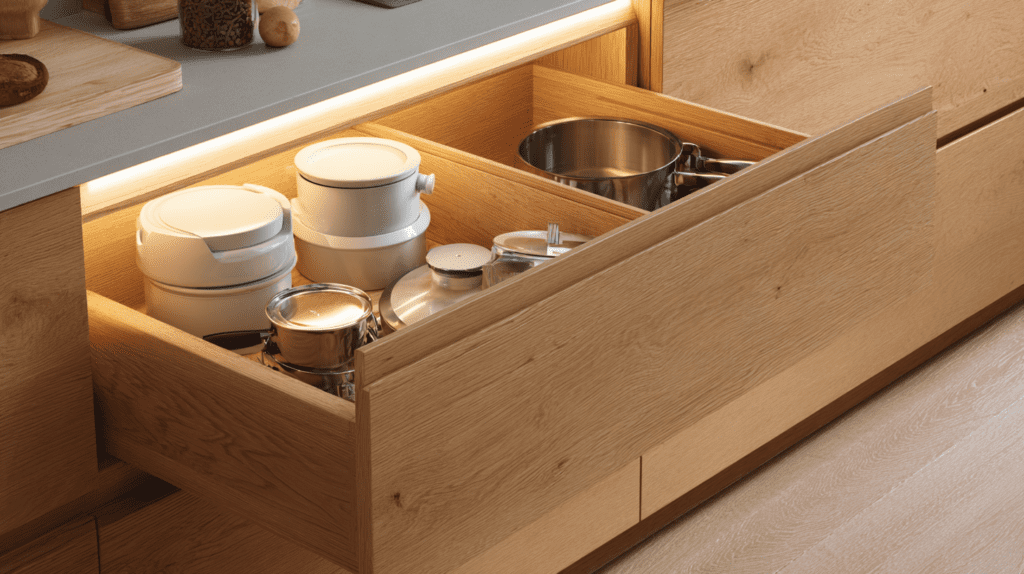
Second, deep pull-out drawers at base level instead of standard cupboards with shelves. Items stored in a standard base cupboard with shelves are invisible and inaccessible — the thing you want is always at the back behind four things you need to move first. Pull-out drawers make everything visible and reachable with one motion. This single change, applied to the base units under the hob and sink, typically reduces meal-preparation time noticeably and frustration considerably.
Third, appliances off the counter. In a small kitchen, the toaster, the coffee machine, and the stand mixer each consume roughly 15–20% of the available counter space. Moving the toaster and coffee machine into a dedicated appliance cupboard — a base cabinet or a lower section of a tall unit with a pull-out shelf — recovers the counter space that most people assume they simply don’t have.
Before buying any new storage for a small kitchen, do this first: remove everything from the countertops and put it all in boxes. Live with empty countertops for one week. Note which items you actually reach for daily — those go back. Everything else finds a home in a cabinet or leaves the kitchen entirely. Most people discover that 60–70% of their counter clutter is items they use once a week or less. Clearing them creates more usable space than any storage product you could buy.
The layout changes that make a small kitchen feel genuinely bigger
Beyond storage and workflow, three visual decisions determine whether a small kitchen feels cramped or surprisingly spacious. None of them are expensive. All of them are consistently underused.
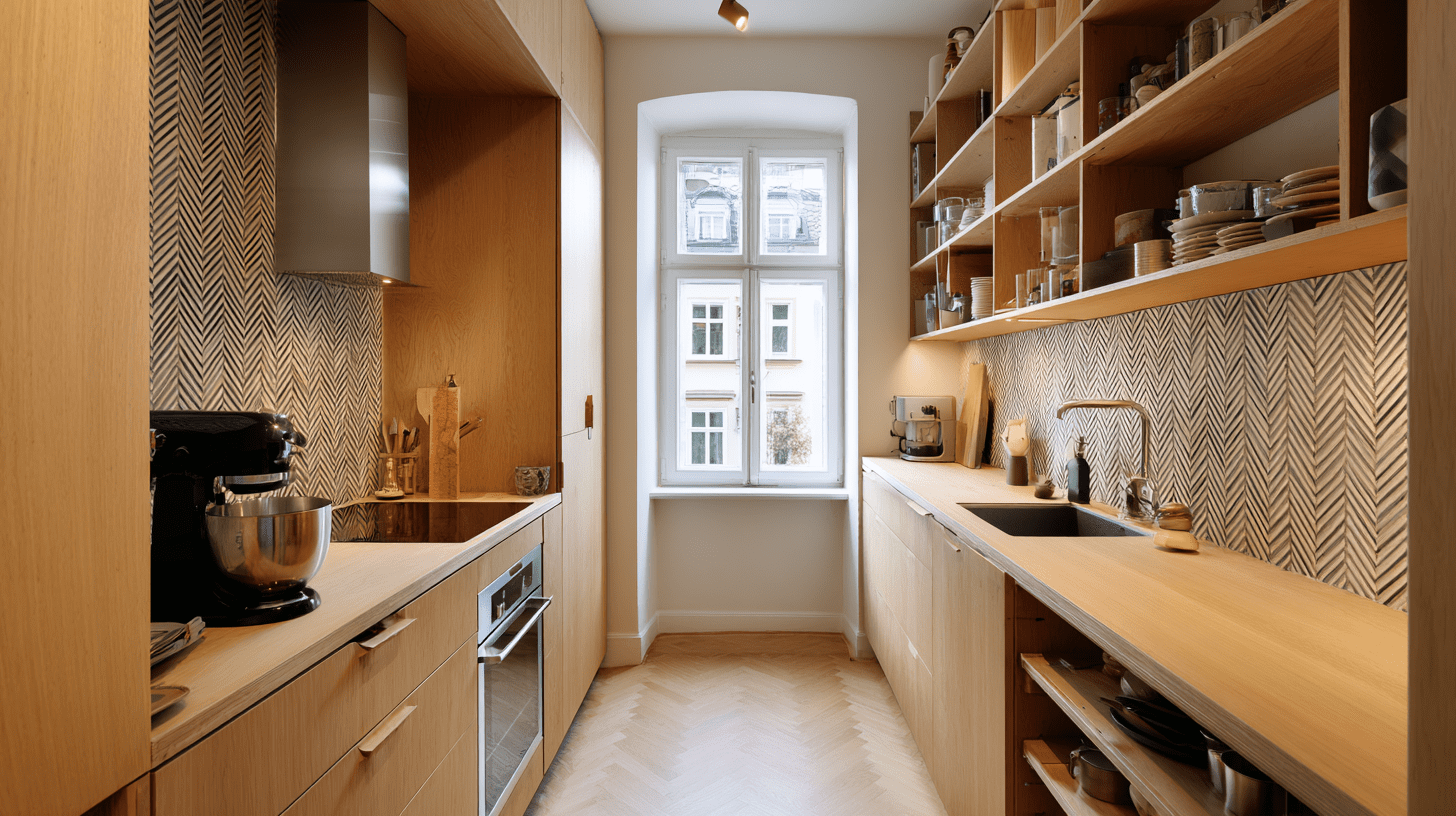
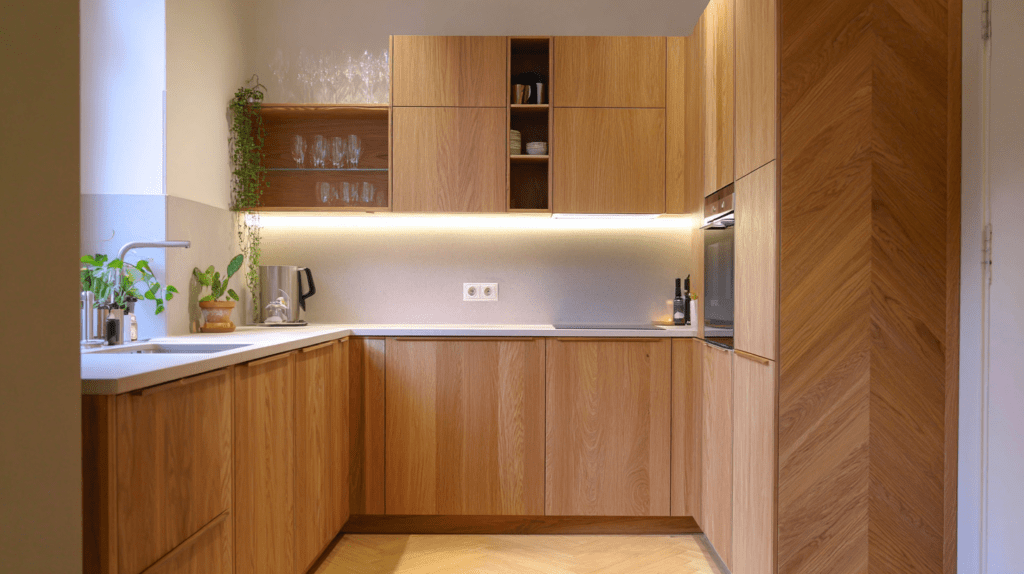
The first is continuity of surface material. A small kitchen that uses three or four different materials — tiled floor, wood countertop, different upper cabinet colour, contrasting backsplash — has too many visual interruptions. Each material transition draws the eye and fragments the space. A small kitchen that uses two materials consistently — one for all the surfaces, one for the cabinets — reads as larger because the eye moves across it without stopping.
In Germany, where the combination of oak or light wood cabinetry with a single consistent stone-effect or ceramic countertop running all the way to the backsplash is both practical and increasingly standard, this is the material combination that consistently makes a small kitchen feel well-considered rather than compromised.
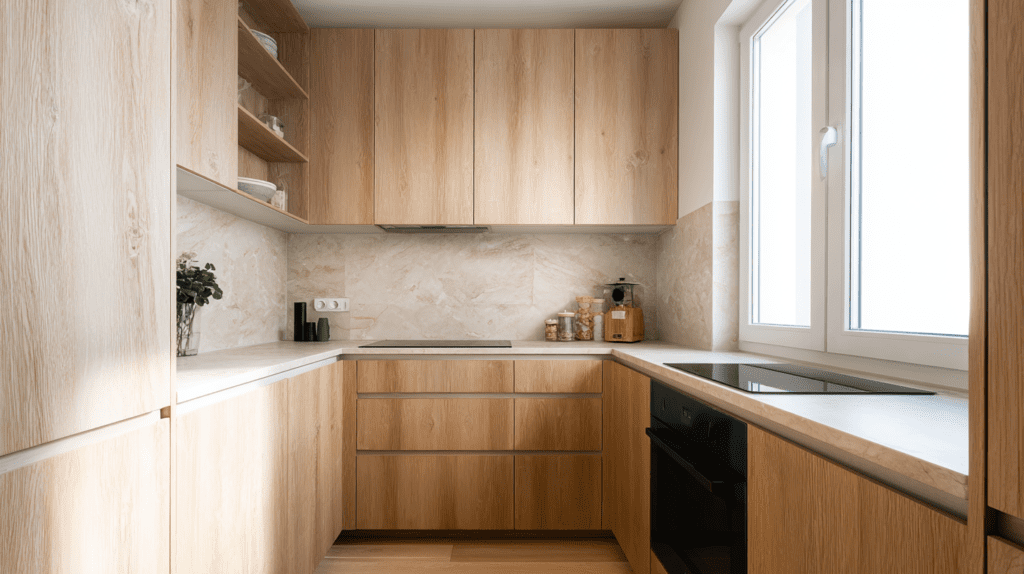
The second is handleless cabinets. Handles and knobs read as visual interruptions — small ones, but multiplied across eight or ten cabinet doors they create a pattern of noise that makes a small kitchen feel busier than it is. Push-to-open mechanisms or J-pull profiles (a routed groove rather than a handle) eliminate this entirely and add roughly €0 to the cost of new cabinetry while meaningfully reducing visual complexity.
The third is a single open shelf. One open shelf in a small kitchen — typically positioned at eye level on the wall opposite the main run of cabinets — creates the visual breathing room that a wall of closed cabinets does not. It should hold three to five items maximum: everyday glasses, a small plant, one or two objects. Its job is not storage. Its job is to give the eye somewhere to rest.
What a small kitchen renovation actually costs in Germany
The cost of a small kitchen renovation in Germany varies enormously depending on scope — from a €500 weekend project to a €15,000 full fit-out with custom cabinetry. Understanding which interventions deliver the most return at each budget level changes the decision completely.
For under €1,000 you can: replace all cabinet doors and drawer fronts without touching the carcasses (from €400 for a 6 m² kitchen with standard sizes), add ceiling-height filler cabinets above existing units (from €300 with flat-pack components), install under-cabinet LED lighting throughout (€60–€120), and add pull-out organisers inside existing base cabinets (€30–€60 per unit). These changes address the lighting problem, most of the storage placement problem, and the visual continuity question — without touching a single pipe, cable, or structural element.
For €2,000–€5,000 you can work with a carpenter to build custom ceiling-height cabinets, replace base cupboards with proper pull-out drawer units, create an integrated appliance garage, and achieve the kind of material continuity that flat-pack kitchens rarely deliver. In Germany, where KfW energy efficiency grants sometimes apply to renovation work and Handwerker (licensed tradespeople) are highly regulated and reliably skilled, this is the budget range where most small kitchens genuinely transform.
For more on what to ask before hiring any renovation professional, our guide on 5 questions to ask before hiring a contractor covers the questions that separate reliable professionals from the ones who cause problems — written specifically for kitchen work.
🔨 Need a professional for this project?
A custom small kitchen designed around your specific footprint, appliances, and workflow — built by a licensed German Handwerker — delivers results that no flat-pack system can match. Furnero connects you with vetted kitchen fitters and carpenters across Europe who specialise in making the most of compact spaces.
The small kitchen that stops making you dread cooking
The test of a well-designed small kitchen isn’t how it looks in a photograph. It’s what happens at 7pm on a Tuesday when you’re cooking dinner after a long day and your partner is trying to help. Does the space allow two people to move? Can you find what you need without thinking? Is there somewhere to put the chopping board while you stir the pan? Does the kitchen feel like a room you’re working in, or a room that’s working against you?
A small kitchen that passes that test doesn’t require more square metres. It requires a layout where the work triangle is efficient, storage is at the right height and properly concealed, the lighting eliminates shadow, and the visual choices reduce complexity rather than adding to it. None of these are large projects. Together they change the relationship you have with the most-used room in your home — and according to HGTV’s research on kitchen renovation impact, a well-executed kitchen upgrade consistently delivers the highest return of any single room renovation.
In short, your small kitchen isn’t asking for more space. It’s asking for better decisions about the space it already has.
✅ Key Takeaways
- A small kitchen that fights you every time you cook is almost always a layout problem, not a size problem.
- Fix the work triangle first: hob, sink, and fridge should form an efficient path — not a straight line on one wall, not a cross-kitchen detour.
- Under-cabinet LED lighting costs €40–€80 and transforms how a small kitchen feels to work in — it’s the highest-return change at any budget.
- Ceiling-height cabinets recover 40–60 cm of wasted space above standard upper units — equivalent to one full extra cabinet without adding floor space.
- Pull-out base drawers make everything visible and reachable in one motion — replacing standard cupboard shelves is consistently the most practical small kitchen upgrade.
- Material continuity (same surface across countertop and backsplash, one cabinet colour to ceiling) makes a small kitchen feel significantly larger with zero extra space.
✅ Key Takeaways
- A small kitchen that fights you every time you cook is almost always a layout problem, not a size problem.
- Fix the work triangle first: hob, sink, and fridge should form an efficient path — not a straight line on one wall, not a cross-kitchen detour.
- Under-cabinet LED lighting costs €40–€80 and transforms how a small kitchen feels to work in — it’s the highest-return change at any budget.
- Ceiling-height cabinets recover 40–60 cm of wasted space above standard upper units — equivalent to one full extra cabinet without adding floor space.
- Pull-out base drawers make everything visible and reachable in one motion — replacing standard cupboard shelves is consistently the most practical small kitchen upgrade.
- Material continuity (same surface across countertop and backsplash, one cabinet colour to ceiling) makes a small kitchen feel significantly larger with zero extra space.