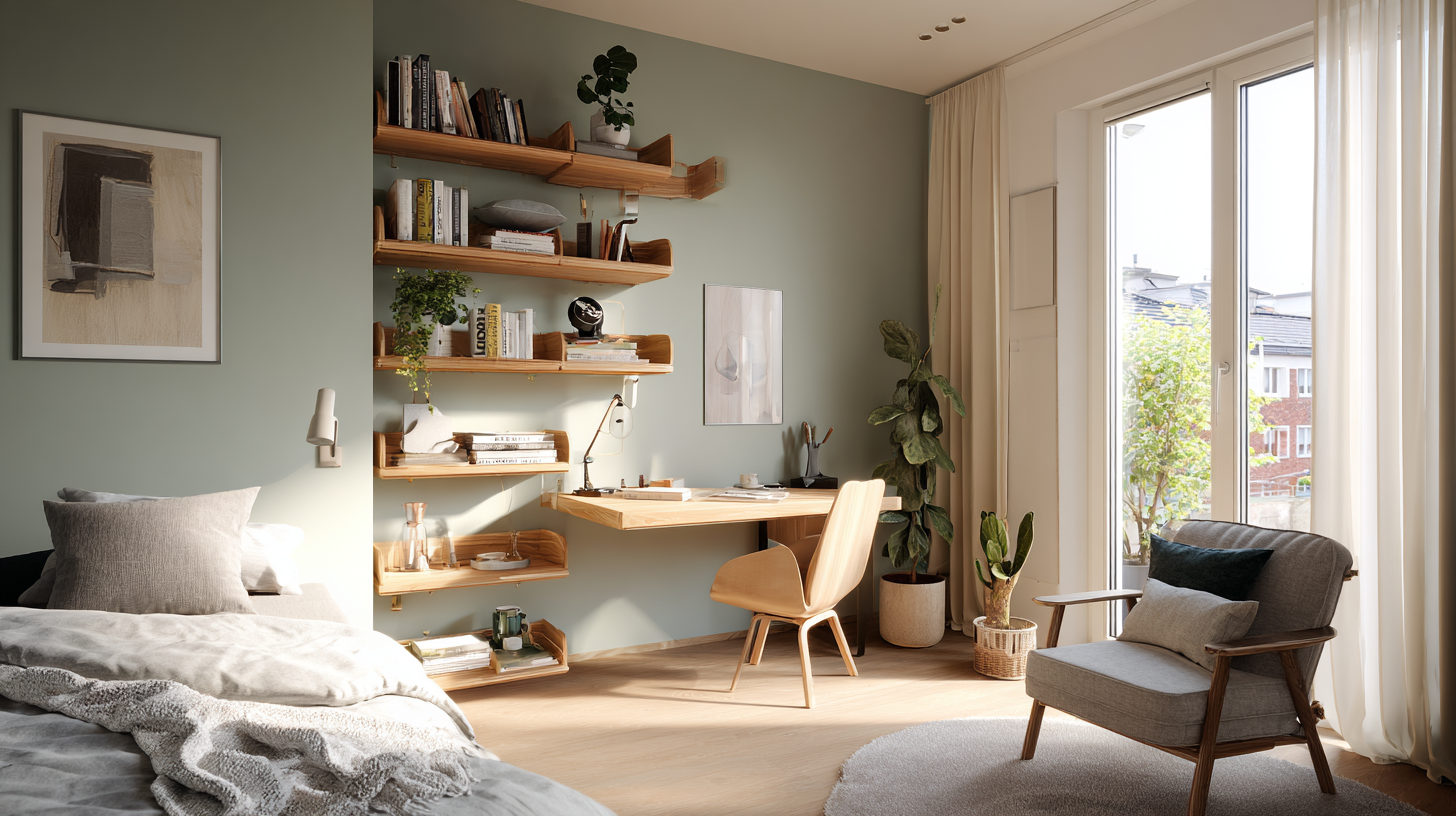
Category: Guest Room · #Design-Guide
💰 Cost: €500–€3,000 depending on Murphy bed and built-in choices · 🔧 Difficulty: Moderate to Complex — Murphy bed installation requires a carpenter
Think about how many nights per year someone actually sleeps in your spare room. For most households, the honest answer is somewhere between four and twelve. The rest of the year, that guest room sits empty — a dedicated room doing almost nothing, taking up space that costs the same per square metre as every other room in your home. However, the problem isn’t the guest room itself. The problem is that it was designed for one narrow purpose and then left to justify that decision for the next twenty years.
The 2026 home has moved well past that logic. In fact, the most common room renovation request across Europe right now is the flex room — a space designed to switch roles cleanly between work and hosting. And the guest room is the most obvious candidate. Because it’s a contained, quiet room with its own door, it’s architecturally perfect for a home office. The only thing standing between you and a room that earns its floor space every day is knowing how to design for both uses without sacrificing either.
This guide covers exactly that. From the furniture decisions that make a guest room work as a real home office, to the design tricks that mean a guest can walk in and feel genuinely welcomed — not like they’re sleeping in your filing cabinet. Here’s how to design a guest room that doubles as something your household actually uses every day.
- Why the "spare room" concept is finally over
- The zone strategy: how one room becomes two
- The video call background: design the wall behind you
- Making the guest feel like a guest, not a colleague
- The storage that holds both lives
- The real test: would a guest feel welcome here, and would you actually work here?
Why the “spare room” concept is finally over
For decades, the spare room existed as a holding pattern. A room that “might be useful one day,” furnished with whatever didn’t fit elsewhere, and quietly ignored the rest of the time. However, two things have changed that thinking permanently.
The first is hybrid and remote work. More than 28% of working adults in Europe now work from home at least part of the time, and that number has been rising steadily since 2022. A dedicated home workspace is no longer a luxury or a pandemic habit — it’s a legitimate part of how households function. A dining table or sofa simply doesn’t deliver the focus, ergonomics, or camera-ready background that professional remote work requires.
The second change is a shift in how homeowners think about square metres. Floor space is expensive. A room that serves one function four nights a year and sits idle for the other 361 is, by any reasonable measure, a poor use of that space. As a result, the most common room transformation in 2025 and 2026 is the spare room redesign — turning an underused space into a room that justifies its floor plan every single day.
The guest room home office combination isn’t a compromise. In fact, done well, it’s better than either a pure spare room or a pure home office. Guests get a room that feels like a boutique hotel — thoughtfully furnished, properly equipped, and separate from the rest of the house. And the home office gets the one thing that most people lack: a room with a door.
The zone strategy: how one room becomes two
The biggest mistake in a guest room home office is treating the two uses as competitors. The thinking goes: the bed is the guest room element, the desk is the office element, and the room has to switch awkwardly between them. However, this misses the real design opportunity.
The better approach is to design the room so that work mode and guest mode feel like natural states of the same space — not like two different rooms sharing a floor plan. Here’s how zoning makes this possible.
The Murphy bed as a room transformer
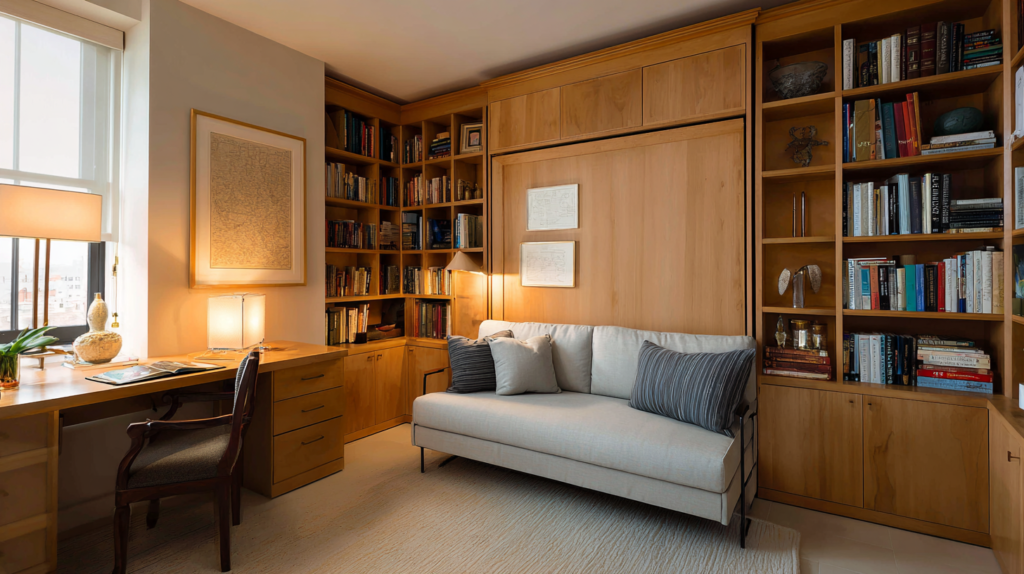
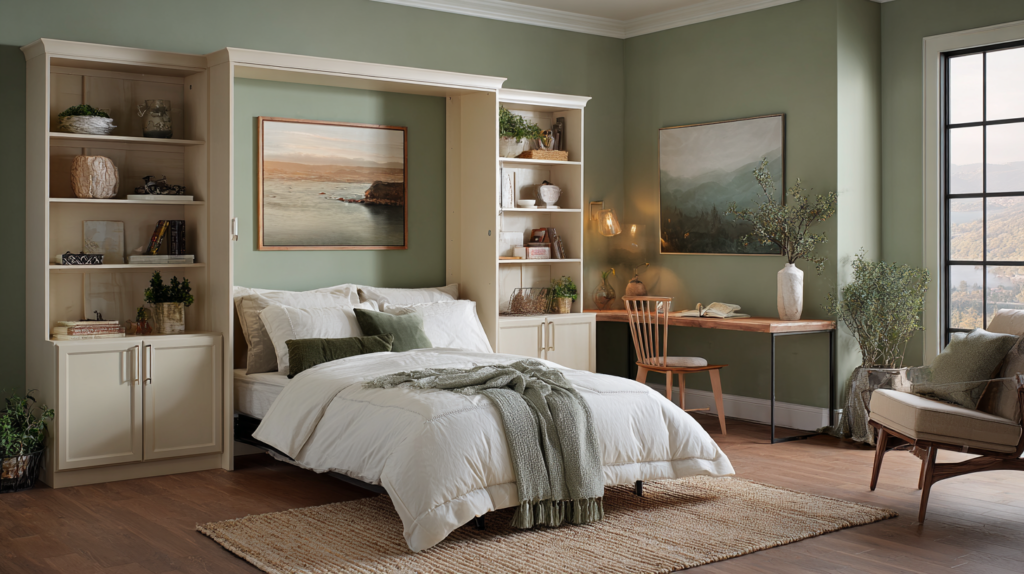
A wall-integrated Murphy bed is the central design element of almost every successful guest room home office. When the bed is closed, the entire face of the unit becomes a shelving, storage, and desk system that looks like built-in joinery. When the bed opens, it takes exactly the space it needs — and the desk folds away, the chair tucks under, and the room reads as a proper bedroom. The visual transition is seamless because both states use the same unit. The room doesn’t look like it has two personalities — it looks like one carefully considered space.
The desk as a design-led piece
Because the desk will be visible every day — both on video calls and to visiting guests — it needs to be well-made and beautiful, not just functional. A wall-mounted oak desk at 70 cm depth gives plenty of workspace. Furthermore, a desk that looks like furniture (rather than office equipment) means the room never has the “working-from-a-bedroom” feel that undermines so many home office setups.
The armchair as a dual-purpose anchor
A comfortable armchair in the guest room corner serves the home office user during breaks and serves the guest as a reading or dressing chair. It’s also one of the most important camera-background elements in any home office. Position it against the most interesting wall in the room — a warm-painted feature wall, a gallery arrangement, or a well-lit bookshelf — and your video call background will look intentional rather than accidental.
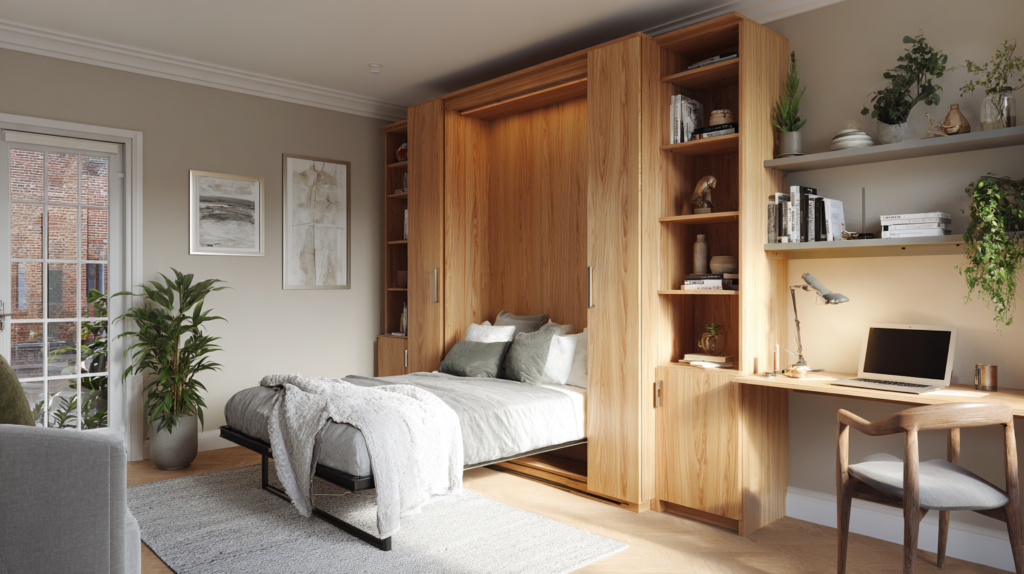
Before ordering a Murphy bed, measure the ceiling-to-floor height carefully. Most wall bed systems require a minimum ceiling height of 220 cm. Also check the swing-out depth — the mattress depth plus the frame when horizontal. In a guest room under 12 m², you need at least 220 cm of clear floor space from the wall to use a standard double Murphy bed comfortably.
The video call background: design the wall behind you
One element that most home office guides ignore is the video call background. Because remote workers are visible on screen every day, the wall behind the desk has become a functional design element — not just a decoration decision. However, in a guest room home office, it also shapes what guests see when they enter the room.
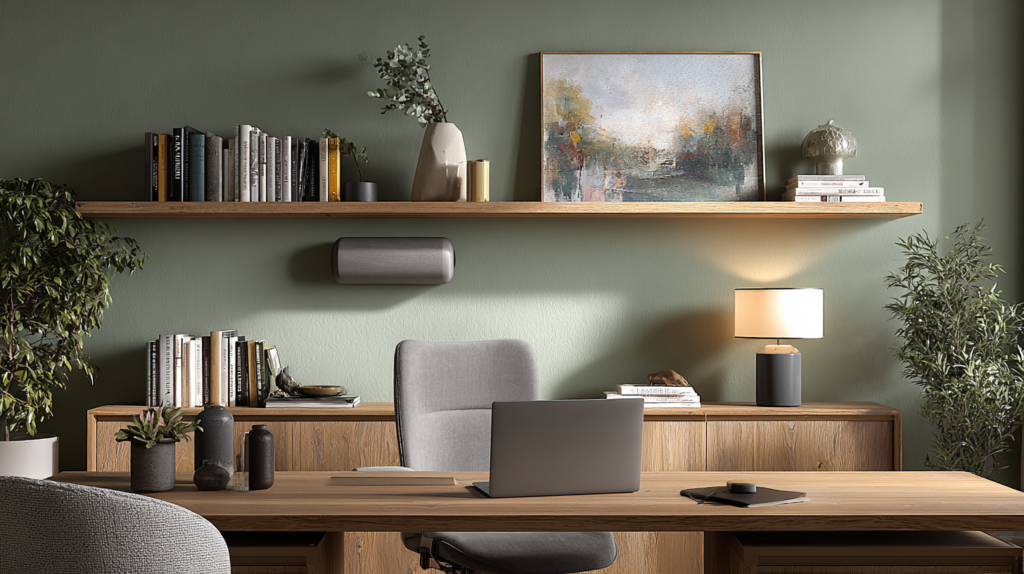
The 2026 approach to the camera wall is intentional layering. Rather than a blank painted surface, the best video call backgrounds use a combination of three to five elements arranged so that the composition reads clearly through a camera lens:
- A warm-toned wall in sage green, terracotta, taupe or warm off-white creates depth without visual noise. All-white reads flat on camera. Dark colours absorb light and make the face appear poorly lit.
- Floating shelves with curated objects. A shelf with three to five objects — a plant, a ceramic piece, a few books, and one small framed print — gives the background texture and personality. Keep the arrangement sparse. More than seven objects reads as cluttered through a camera lens.
- A single piece of framed artwork. A large print or framed photograph (at least 50×70 cm) gives the camera something to settle on and makes the background feel designed rather than incidental.
- Warm side lighting. A table lamp or wall sconce slightly to one side of the desk casts warm light on the face and makes the background glow. It’s the single most impactful upgrade in any home office, costing as little as €30.
For the guest, this same background wall becomes the most interesting feature of their temporary bedroom. A well-designed wall is more welcoming than a bare one — so the camera investment doubles as hospitality.
Making the guest feel like a guest, not a colleague
The risk with any guest room home office is that the guest arrives and feels like they’ve been given access to someone else’s workspace rather than their own room. Therefore, the transition from office mode to guest mode needs to be genuinely transformative — not cosmetic.
A few elements make the difference between a guest who feels welcome and one who feels like an afterthought:
Proper bedding, not an afterthought
The single most impactful guest room investment is the quality of the bed. Because guests judge a room by the night they sleep in it, a comfortable mattress, crisp white linen, and two to four proper pillows communicate care in a way that no amount of styling can replace. Also consider a throw blanket at the foot of the bed — it’s a small hotel detail that makes a big impression.
A clear surface for their belongings
A guest needs somewhere to put their phone, a glass of water, and a book. This doesn’t require a dedicated bedside table — a fold-out shelf, a small stool, or a wall-mounted surface does the same job. Furthermore, a small tray or dish for keys and loose items signals that the space was prepared for them specifically.
Somewhere to unpack
Even for a two-night stay, guests feel more comfortable when they can hang a few clothes. A wall-mounted hook rail or a dedicated section of the wardrobe (cleared of your work files) makes the room feel like proper accommodation.
Blackout and lighting control
A guest room home office needs layered lighting anyway — task light for the desk, ambient light for the room, and reading light for the bed. Blackout curtains or blinds serve both the guest’s sleep and the desk worker’s screen clarity. This is one detail where the two uses genuinely reinforce each other.
🔨 Need a professional for this project?
A Murphy bed installation and built-in shelving system is exactly the kind of project where a skilled carpenter makes the difference between a beautiful result and a frustrating one. Furnero is building a vetted directory of home renovation professionals across Europe who specialise in built-in furniture and flex room design.
The storage that holds both lives
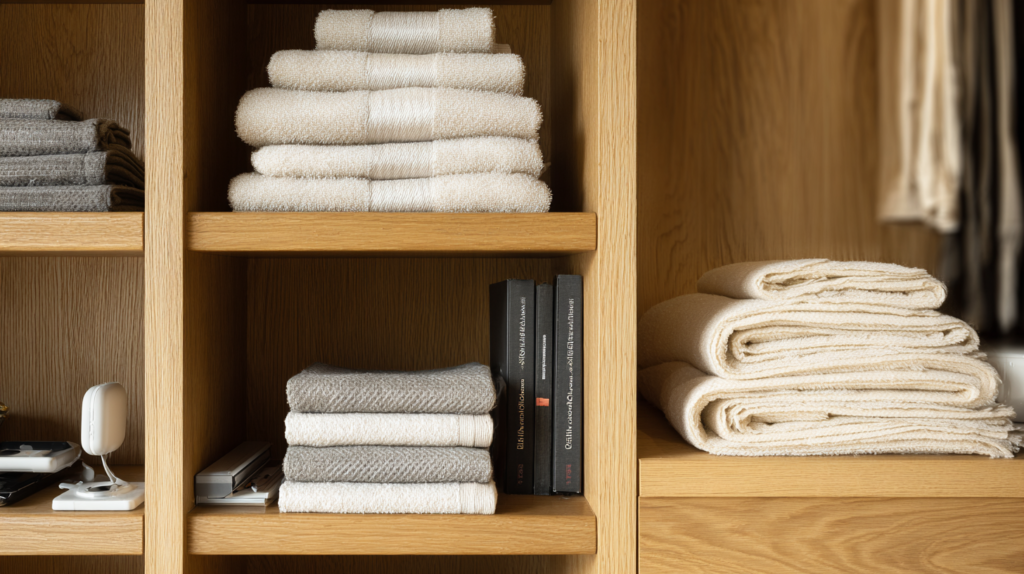
A guest room home office has two sets of storage needs that couldn’t be more different: work files, equipment, cables, and stationery on one hand; guest towels, spare bedding, and clothing space on the other. In fact, managing these two categories without one invading the other is what most flex-room guides get wrong.
The solution is dedicated zones within a single built-in unit. A floor-to-ceiling joinery piece with a Murphy bed at the centre can incorporate closed cabinet sections on either side: one side for the work equipment (with a cable-tidy interior and power sockets), the other for guest linens and the wardrobe rail. Both sets of contents are fully enclosed. When the guest arrives, you open the linen side and close the work side. When they leave, you reverse it. Neither world bleeds into the other.
For the desk surface itself, cable management is the most overlooked detail. A desk with a built-in cable channel, or a simple grommet through to a hidden power strip in the lower cabinet, makes the surface look clean on camera and stay clean for guests. Furthermore, a small wireless charger recessed into the desk surface removes the one cable that otherwise always appears on a tidied desk.
The real test: would a guest feel welcome here, and would you actually work here?
Before committing to a guest room home office design, there are two tests to run — and both need to pass.
The first is the guest test. Imagine someone you care about arriving for a two-night stay. As they put down their bag, do they feel like they’ve been given a proper room, or do they feel like they’re borrowing your workspace? Is there a clear surface for their glass of water? Is the bed inviting? Is there somewhere to hang a coat? A guest room home office that fails this test isn’t a guest room — it’s just an office with a sofa bed shoved in.
The second is the work test. Sit at the desk. Is the light good? Is the background behind you composed and professional? Is there somewhere to put a notebook, a coffee cup, and the things you need without them sitting on top of guest belongings? Can you close the door and focus? A flex room that fails this test isn’t a home office — it’s just a bedroom with a table.
Both tests are achievable in the same space. In fact, the best guest room home offices pass both tests so well that the dual-purpose nature of the room only becomes apparent when you look for it. That’s the standard worth designing for — a guest room that’s a genuinely good place to sleep, and a home office that’s a genuinely good place to work, in the same room, at the same time.
✅ Key Takeaways
- A guest room used fewer than 15 nights per year is one of the most underutilised spaces in any home — redesigning it as a flex room is one of the highest-return renovations available.
- A Murphy bed is the central element of a successful guest room home office — it transforms the room completely between modes without requiring any furniture to be moved.
- Design the wall behind the desk intentionally: warm paint, floating shelves with curated objects, and one good side lamp make both the work background and the guest room feature wall work harder.
- Guest mode requires a few non-negotiables: quality bedding, a surface for a glass of water, and somewhere to hang clothes — without these, guests feel like they’re borrowing a workspace, not staying in a room.
- Built-in joinery with dedicated zones for work equipment and guest items keeps both uses clean and separate — the room switches modes without visual bleed between the two.
- A Murphy bed installation needs a carpenter — the frame must be properly anchored to wall studs and the desk/shelving system built to close tolerances for the transformation to look seamless.
Ready to turn your spare room into a room that works every day?
Furnero connects homeowners with vetted interior designers and carpenters across Europe who specialise in flex rooms, Murphy beds and built-in furniture.